terça-feira, 24 de novembro de 2015

Elektronika MK 60 calculator


I had friends visiting family in Moscow during the summer.


And then they asked me about what I would like to have as a gift from there.

Well, my answer was simple:
Go to a street market and bring me a Russian pocket calculator! The older, the better.

Apparently shopping in street markets can be tricky and be very time consuming.
If you go to the central areas the asking prices is too high, then you spend hours commuting to reach the ones where the prices are lower and by the time you arrive there the fair is closing and most seller are gone.
So they spent a couple of days touring around. I felt a little bit guilty for steeling quality time from them, but hey, they asked!

And here it is.
It was dirty with marks of glue, has a few dents and the keys are scratched.

But is works nicely, as long as the environment light is strong enough to enable the solar panel.


This specimen was made in USSR on Sept-1988 (IX 88 on the back cover) and the official price was 45 Rubles.

The pouch is unusual but nice and soft.


Seven segment 8 digits LCD display, with 3 indicators on the right. From to to bottom:
"П" - Memory in use ( Память = Memory)
"_" - Minus signal
"Е" - Error


The factory seal is in place. It just takes a little steam to be removed without damage.


Time to dismantling the machine.


There is a white ink hand written label with a unknown number: 808039.

The serial number in the back cover is also 6 digits, but it is different: 847948

 
The SoC is a Russian КБ145ВХ3-2 made in 1988 week 08.

The 20µF/6.3V paper electrolytic capacitor was made in 1988 week 06.


This SoC operates from 1.5Volt nominal (with a minimum of 1.2V and a maximum of 1.8V), supplied by a 4 element solar panel, and consumes around 25µA.
This SoC contains 10,000 transistors to support a 5405 bits ROM microcode, RAM registers, ALU, keyboard scan, display decoding and control, synchronization unit and power supply.

I measured the solar panel under strong warm light (60 Watt at 40cm distance) and got 1.42Volt.
All four elements generates about the same voltage of 0.355 Volt. 
This is a little lower than expected but it happens that the capacitor is dry and has resistance leaking, so it is pulling down the power supply a little.

A uncommon design choice by today's standard was to use two АЛ102Г yellow LED diodes to protect the SoC from over-voltage. 

The schema can be downloaded from here.


sexta-feira, 20 de novembro de 2015

CASIO fx-4100P Scientific Calculator

Another small pocket programmable scientific calculator from CASIO.
This one was assembled after 1991 week 14 according to the SoC date code.


Japanese industrial design with attention to detail
Color reverse painting labeling like Japanese used to do on pocket transistor radios from the 60's and 70's, many of them manufactured to be sold with American branding. 


Opening the case is done by undoing five small screws.
To remove the case I had to use a plastic pry tool to release the lateral latches before lifting the bottom side in order to be able to slide it down to release the top side.


Unusual CASIO choice of a SoC from Toshiba T9949A 9114H Japan.
Same remark for the large back cover shield, absent on most of CASIO machines from these series.


While I prefer the independent plastic keys approach like used in the fx-3600P, this rubber membrane key set is working fine and the labeling is resistant to wear; even after a vigorous cleaning with hand dish wash detergent in warm water it retained the full paint and color.  


terça-feira, 17 de novembro de 2015

CASIO fx-3600P scientific calculator


Made after 1985, according to the Hitachi HD43147 SoC processor.

Calculator forensics: arcsin(arccos(arctan(tan(cos(sin(9)))))) = 9.0000157179

Tested in DEG mode.
Typed: 9 sin cos tan INV tan INV cos INV sin
Result1: 9.000015718
Typed: - 9 =
Result2:  1.57179 -05
Typed: x 1000000 =
Result3: 15.7179


Front panel was lose due to film dry glue.


Single 3Volt CR2025 Lithium battery cell.


Two classic axial pass through mount 1/8 Watt, 5% resistors on the PCB back side.
Top = 390 Ohm, Bottom = 220KOhm


PCB front side.
Keyboard keys assembly (foil membrane attached to the PCB).


One unmarked SMD ceramic capacitor.
And the Hitachi HD43147  SoC processor, made in 1985 week 43 (5J 43).


Keyboard rubber membrane.


Real quality plastic keys, where the bottom half sports injection moding manufacturing.


Partial exploded view.


segunda-feira, 16 de novembro de 2015

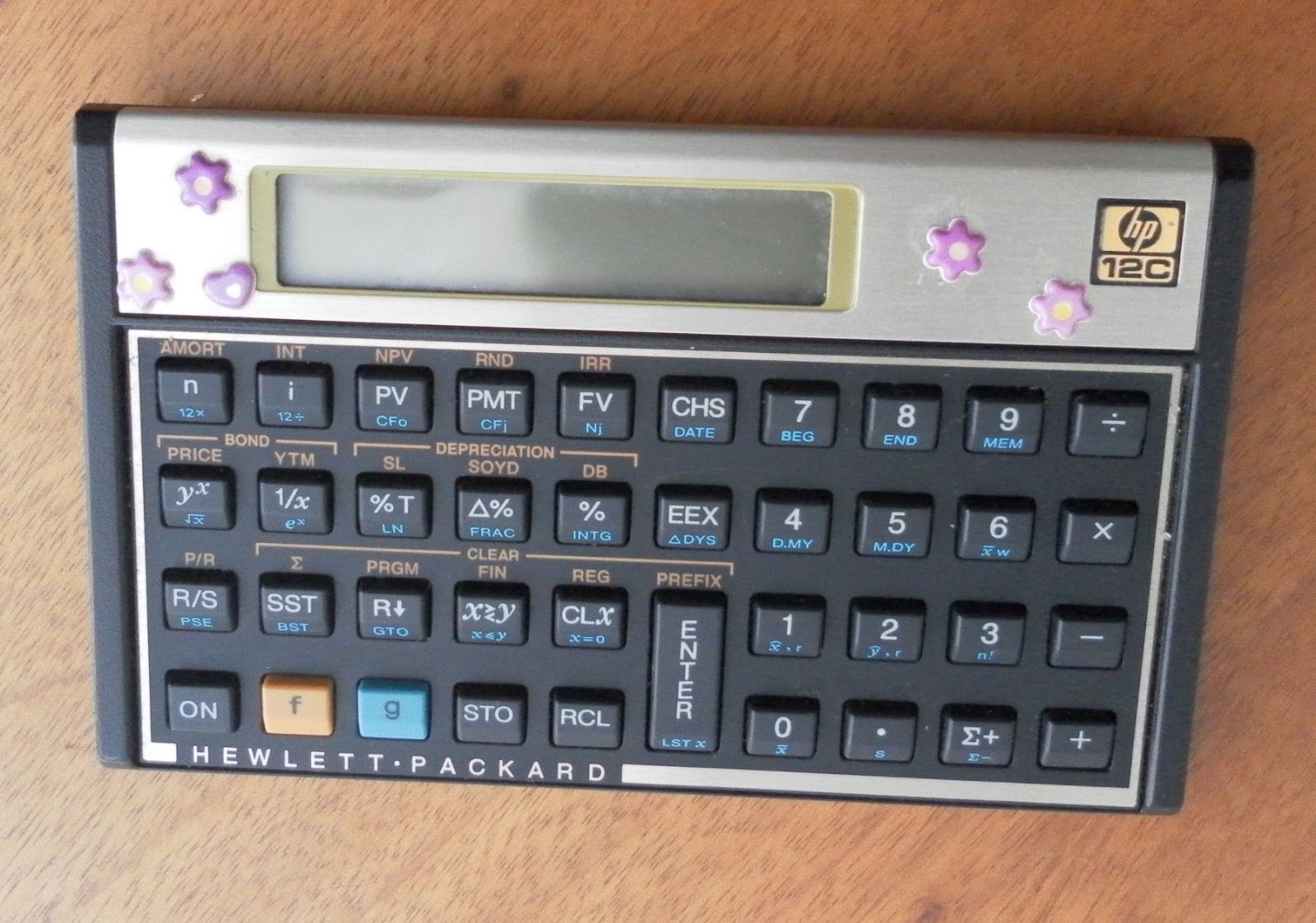
HP-12C Gold 2007

RPN Financial calculator from 2007 week 26.

Got this one from a lady that doesn't need this machine anymore.
How lovely decoration she gave to her cherished calculator!


The calculator developed a fault in the display area.
Pressing lightly on the front bezel above the keyboard fixes the issue.


Time to open the machine and have a look inside.
Opening these HP-12C Gold series from 2007 is easy.
Just remove 5 screws (four of them under the rubber feet).
Then use a plastic pry tool to unlatch and remove the back cover. There is no need to apply force as it can cause damage to the case and to the PCB assembly.


Components listing in the PCB back side:
C1 - 22uF polarized tantalum capacitor
C4 - Unmarked ceramic capacitor (most probably 0.1uF)
L1 - 180uH inductor
U1 - 2AF1-0002 NPAF1A6162-06 0716 Marvell SoC made in Korea 2007 week 16
 

The display missing segments was caused by a bad contact between the PCB and the display assembly.
I had to use a small pliers to tight the seven metal latches a little in order to fix it.


Main parts and tools used to open the case.


After using isopropyl alcohol to clean the front bezel and back cover from glue residues, it was time to reassembly.
The two shield interconnect metal springs have different length. The longer one goes into the hole at the right.


Screws back in place once again.


Self test success.
(from power off state, press and hold "x", press and release "ON", release "x")


segunda-feira, 2 de novembro de 2015

Deli DL-1704 Scientific Calculator

Common to find in the south Africa region.


 Manufacturing date: Sept-2014


Degrees mode.
Type: 9 sin cos tan 2ndF tan 2ndF cos 2ndF sin 
Result1 = 8.99999986


 Get remaining (guard) digits):
Type: Result1 - 8.99999 x 1000000
Result2 = 9.86001


Final result = 8.99999986001
This is identical to the HP-33S and HP-35S results, based on the Sunplus SPLB31A processor.


PCB ref. DL1704FL YX51941-1, date of  2012.06.12.
Note the Reset contacts on the PCB, despite missing the Reset hole on the back cover.


Colorful card box packaging.


It looks very similar to the Citizen SR-35N.
Common Kinpo Electronics manufacturing?


domingo, 27 de setembro de 2015

IKEA vitrine to show off calculators